
A small kitchen can still be practical, comfortable and enjoyable to use. The key is choosing tools that earn their place by serving several purposes, fitting neatly into limited storage and making everyday cooking easier.
Instead of filling cupboards with single-use gadgets, focus on a reliable collection of versatile essentials. The right tools can help you prepare vegetables, cook complete meals, store leftovers and keep your kitchen tidy without taking over the room.
Start with the basics
Before buying specialist equipment, build a strong foundation of simple tools. These are the items you are most likely to use several times a week.
A good chef’s knife
A sharp chef’s knife is one of the most useful tools in any kitchen. It can be used to chop vegetables, slice meat, cut herbs and prepare fruit. Choose a comfortable knife that feels balanced in your hand rather than focusing only on size.
A medium-sized blade may be easier to control in a compact kitchen. Keep it sharp with a suitable knife sharpener or honing tool, and store it safely in a knife block, drawer insert or protective cover.
It is also useful to have:
– A small paring knife for peeling and detailed work
– A serrated knife for bread and soft fruit
– A sturdy chopping board
A single large chopping board may be enough, although a smaller board can be convenient when preparing quick snacks or small quantities.
Measuring cups and spoons
Accurate measurements make cooking and baking more consistent. A compact set of measuring cups and spoons can handle most recipes without using much storage space.
If you bake regularly, consider adding digital kitchen scales. Scales are especially useful for measuring flour, rice and other dry ingredients accurately. Look for a slim model that can be stored upright or in a drawer.
Mixing bowls
Choose nesting mixing bowls that fit inside one another. Stainless steel, glass and durable plastic are all practical options.
A set with several sizes is useful for preparing ingredients, mixing batters, serving salads and storing food temporarily. Bowls with flat bases are easier to use on a small bench, while those with pouring lips can help reduce spills.
Choose versatile cookware
Cookware takes up considerable space, so each piece should have more than one purpose.
One quality frying pan
A medium or large frying pan can be used for eggs, vegetables, stir-fries, toasted sandwiches and one-pan meals. A pan with a comfortable handle and even heat distribution is a worthwhile investment.
If cupboard space is tight, select a pan that can move easily from the stovetop to the oven, provided it is suitable for both. Always check the manufacturer’s instructions, particularly for handles and heat-resistant coatings.
A saucepan with a lid
A medium saucepan is useful for cooking pasta, rice, soup, sauces and steamed vegetables. A well-fitting lid also helps food cook more efficiently and makes it easier to store leftovers once the pan has cooled.
A saucepan with measurement markings inside can be helpful when preparing grains, sauces or drinks.
A multipurpose pot
If you often cook larger meals, choose one pot that can handle soups, stews, pasta and casseroles. A wide pot may be more practical than a tall, narrow one because it can also be used for browning ingredients.
In a very small kitchen, you may not need both a large pot and a Dutch oven. Select the option that best suits your cooking habits and storage space.
Add tools for preparation
Preparation tools can save time, but they should be chosen carefully. Avoid buying several gadgets that perform the same task.
A box grater
A box grater can shred cheese and vegetables, create fine zest and produce breadcrumbs. It combines several functions in one compact tool and can usually be stored inside a cupboard or a large drawer.
A colander
A collapsible colander is a smart choice for a small kitchen. It can drain pasta, rinse vegetables and wash fruit, then fold flat for storage.
If you prefer a solid colander, look for a model that fits securely inside your sink or over a suitable bowl.
A vegetable peeler
A reliable peeler is useful for potatoes, carrots, apples and other produce. Choose one with a comfortable grip and a blade that moves smoothly. Some peelers are designed for right- or left-handed use, so check which style suits you.
Kitchen scissors
Kitchen scissors can cut herbs, open food packaging and trim poultry or baking paper. Keep them separate from general household scissors and choose a model that comes apart for easy cleaning if possible.
Keep a small set of utensils
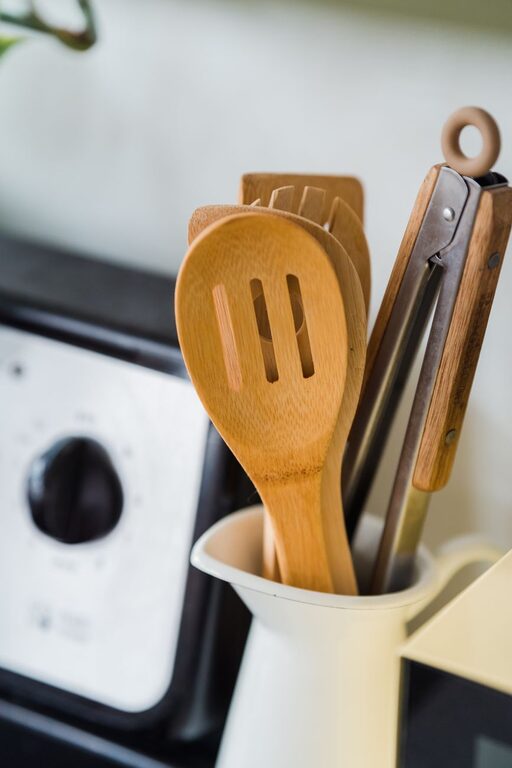
A compact selection of utensils is usually enough for everyday cooking. Store them in a container beside the cooktop or in a drawer organiser.
Consider including:
– A wooden or silicone spoon
– A heat-resistant spatula
– A turner for eggs and pancakes
– A pair of kitchen tongs
– A ladle
– A whisk
– A slotted spoon
Silicone utensils are useful for coated cookware because they are less likely to scratch the surface. Wooden utensils are gentle on pans and comfortable to use, although they need to be washed and dried properly.
Tongs are particularly versatile. They can turn food in a pan, serve pasta, toss salads and handle hot items without requiring several separate tools.
Consider compact appliances
Small appliances can be useful, but they should match your routine. An appliance that is used once a year may not justify the storage space.
Electric kettle
An electric kettle is useful for tea, coffee, instant meals and speeding up cooking water. A compact model with a clear water level and automatic shut-off is practical for most homes.
Toaster or toaster oven
Choose between a standard toaster and a compact toaster oven based on your needs. A toaster is smaller and suits everyday bread, while a toaster oven can heat snacks, roast small portions and cook items without using the main oven.
Stick blender
A stick blender takes up less space than a traditional blender and is useful for soups, sauces, smoothies and purées. Look for a model with a removable blending attachment that is easy to clean.
If you rarely blend food, you may prefer to skip this appliance and use a standard whisk or masher instead.
Make storage work harder
Good storage is as important as the tools themselves. Use vertical space where possible with shelf risers, wall rails or hooks. A magnetic strip can hold suitable metal tools, while a pegboard can organise utensils without taking up bench space.
Choose stackable containers for dry goods and leftovers. Clear containers make it easier to see what you have, reducing duplicate purchases and food waste.
Useful storage options include:
– Nesting pots and bowls
– Stackable food containers
– Drawer dividers
– Shelf risers
– Wall-mounted hooks
– A narrow trolley for extra storage
Keep frequently used tools within easy reach and store occasional items in higher cupboards or less accessible areas.
Select tools based on your habits
There is no single perfect kitchen set. Someone who cooks soups and curries may need a larger pot, while a keen baker may prioritise scales, baking tins and a rolling pin.
Before buying a new item, ask:
- How often will I use it?
- Can it perform more than one task?
- Do I already own something similar?
- Where will it be stored?
- Is it easy to clean?
A small kitchen works best when every tool has a clear purpose. By choosing versatile equipment, using clever storage and avoiding unnecessary gadgets, you can create a cooking space that feels organised and capable, whatever its size.